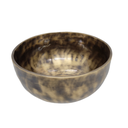
Size is the single biggest factor in how a singing bowl sounds, feels, and fits into your practice. Here's how to match diameter to purpose — with charts you can explore, bowls you can hear, and answers to the questions buyers ask most.
The Tasting Bench
Tap a bowl to hear an approximation of its voice. Notice how pitch drops and sustain stretches as the bowl grows.
Why size matters more than anything else
Walk into any shop in Kathmandu or Patan and you'll see walls of bowls that look nearly identical except for one thing: diameter. That one variable quietly decides almost everything about the instrument. The physics is simple — a larger vessel has more metal to vibrate, and more mass vibrates more slowly. Slower vibration means a lower pitch, a longer sustain, and a tone you feel in your chest rather than hear in your ears.
A small bowl, by contrast, is quick and bright. It speaks instantly when struck, rings high and clear, and fades within seconds. Neither is "better." A meditation teacher opening a class, a sound therapist working on the body, and a traveler who wants a bowl in a backpack each need a different size.
The chart below maps the relationship. Hover or tap the bars to compare exact ranges, and use the toggle to switch between pitch and sustain.
Pitch and sustain by bowl size
Typical fundamental frequency range (Hz) — lower bars mean deeper voices.
How the tone actually fades: decay curves
Frequency tells you where a bowl sits; decay tells you how it leaves. Strike all three sizes at once and the difference is dramatic. A small bowl gives up most of its energy in the first two seconds — a clean exclamation mark. A large bowl is still humming at half volume when the small one has gone silent, and its overtones keep blooming for half a minute or more.
Trace the curves below with your cursor to read the exact relative volume at any moment after the strike.
Volume decay after a single strike
Relative loudness (%) over time. Hover any point for exact values; click legend names to isolate a size.
Small bowls (3–6 inches): the bright messenger
Small bowls are the soprano voices of the family. Struck with a light mallet, they produce a clean, bell-like chime in roughly the 400–900 Hz range that cuts through ambient noise without overwhelming a room. The sound decays in two to eight seconds — short enough to act as punctuation rather than atmosphere.
That makes them ideal as timers and signals: opening and closing a meditation sit, marking intervals in a yoga class, or calling a household to dinner with considerably more grace than shouting. They're also the natural choice for desks, altars, travel, and small apartments. At 200–600 grams, a small bowl rides happily in a carry-on.
The trade-off is rim play. Coaxing a sustained "singing" tone by circling the rim is hardest on small bowls — the sweet spot is narrow and the friction window unforgiving. If your dream is that continuous swirling drone, don't start here.
- Best for
- Meditation bells, intervals, travel, desks, gifts, beginners on a budget
- Tone
- High, bright, clear; short decay
- Weight
- Roughly 200–600 g
- Watch out
- Difficult to "sing" with a rim mallet; thin sound for sound baths
Medium bowls (7–9 inches): the all-rounder
If you only ever own one singing bowl, most practitioners will steer you here, and the data backs them up. Medium bowls sit in the 200–400 Hz band — low enough to feel warm and grounding, high enough to stay articulate. Sustain stretches to ten or twenty seconds, and the wider rim makes the circling technique dramatically easier to learn. Most people get a medium bowl singing within their first practice session.
This is the workhorse size for personal meditation, yoga studios, and small group sessions. It's loud enough to fill a living room, light enough (700 g–1.5 kg) to hold in one palm using the traditional fingertip support, and versatile enough to be struck, sung, or played with water inside for shimmering harmonic effects.
- Best for
- First "serious" bowl, daily practice, yoga classes, learning rim technique
- Tone
- Warm mid-range with audible harmonic layers; 10–20 s sustain
- Weight
- Roughly 700 g – 1.5 kg
- Watch out
- Jack of all trades — masters neither the chime of small nor the depth of large
Large bowls (10–14+ inches): the deep ocean
Large bowls trade portability for physical presence. Their fundamentals drop below 200 Hz — some monsters reach down toward 85 Hz — and at those frequencies sound stops being something you merely hear. Vibration travels through floors, cushions, and bodies. Sustain can exceed thirty seconds, with overtones blooming and interfering in slow waves long after the strike.
This is the territory of sound baths, sound therapy, and vibrational bodywork. Practitioners place large bowls directly on or beside the body so clients feel the oscillation in muscle and bone. In group settings, a single large bowl can anchor a room of forty people. The cost is literal heft: two to seven kilograms of hand-hammered bronze, a price tag to match, and a permanent spot on the floor rather than a shelf.
- Best for
- Sound baths, therapy practice, on-body work, large groups, deep relaxation
- Tone
- Low, enveloping, felt as much as heard; 20–40+ s sustain
- Weight
- Roughly 2–7 kg
- Watch out
- Expensive, immobile, and overwhelming in tiny rooms; slow to respond when struck softly
Weight grows faster than diameter
A common surprise for first-time buyers: doubling a bowl's diameter doesn't double its weight — it can quadruple it or more, because the metal scales with the bowl's whole surface and wall thickness. A 5-inch bowl weighs about as much as a paperback; a 13-inch bowl weighs as much as a full kettlebell. If you plan to hold the bowl in your palm while playing, this curve matters more than any other.
Typical weight by diameter
Average weight (kg) of handmade Himalayan bowls at each diameter. The shaded zones mark the small / medium / large bands.
What each size costs
Price tracks size for an obvious reason — bronze is sold by weight, and hammering a big bowl takes an artisan days rather than hours. The ranges below cover typical handmade Himalayan bowls; machine-made bowls cost less, while antiques and master-smith pieces can multiply these figures several times over. Use them to sanity-check a quote, not as a ceiling on quality.
Typical price range by size (USD)
Handmade Himalayan bowls, new. Hover a bar to read the low–high range.
Match the bowl to the room
A bowl that sounds glorious in a shop can vanish in a hall or boom uncomfortably in a bedroom. As a rule of thumb, a bowl comfortably fills a space when its volume and sustain can reach the far wall before the tone fades. The chart below shows the room sizes each class realistically serves — note how the large bowl's range starts where the small bowl's ends.
Effective room coverage
Approximate room area (m²) each size can fill with clearly audible tone. Hover to read ranges.
Playing techniques: what each size can do
Size also decides how you can play. Striking works on everything. Rim singing favors the wide, stable lip of a medium bowl. Water play — adding a little water for warbling, dolphin-like overtones — needs enough basin to hold it. And on-body placement, the core of vibrational therapy, demands the mass and low frequency of a large bowl. Compare the scores below, and toggle techniques in the legend to focus the view.
Technique suitability by size
Scores from 1 (poor) to 5 (excellent). Click legend items to show or hide techniques.
How the three sizes compare across real uses
Specs only matter in the context of what you'll actually do with the bowl. The radar below scores each size from 1 (poor fit) to 5 (excellent fit) across six common scenarios. Tap the legend to hide or show a size and isolate the comparison.
Fit by use case
Scores reflect typical suitability, 1 = poor · 5 = excellent. Click legend items to toggle sizes.
Find your size in four questions
Answer the prompts below and the guide will tally which size fits your situation. There are no wrong answers — only mismatched bowls.
Bowl-fit mini quiz
1 · What's the bowl's main job?
2 · Where will it live?
3 · Do you want to learn the rim-singing technique?
4 · What's your budget feeling?
Frequently asked questions about singing bowl sizes
Quick answers to the questions buyers search for most. Tap a question to expand it.
What size singing bowl is best for beginners?
A medium bowl of 7–9 inches is the best singing bowl size for most beginners. Its wide rim makes the singing (rim-circling) technique far easier to learn, its 200–400 Hz tone is warm and forgiving, and at 700 g – 1.5 kg it's light enough to hold in one palm. Most beginners produce their first sustained tone on a medium bowl within a single practice session.
What size singing bowl is best for meditation?
It depends on how you meditate. To mark the start and end of sessions, a small 3–6 inch bowl with a clear chime is ideal. To meditate with continuous sound, choose a medium 7–9 inch bowl — its 10–20 second sustain and easy rim play create a steady sonic anchor for breath-focused practice.
What size singing bowl is best for sound healing and sound baths?
Sound healers favor large bowls of 10–14 inches or more. Their low fundamentals (85–200 Hz) produce vibration you can feel through the body, sustain for 20–40+ seconds, and fill large rooms — exactly what sound baths and on-body vibrational therapy require. Many practitioners pair one large anchor bowl with several medium bowls for melodic layering.
Are larger singing bowls better than small ones?
No — larger singing bowls are not better, just different. Large bowls give deeper tones and longer sustain, but they're heavy, costly, and stay put. Small bowls are bright, portable, and perfect as meditation bells. The best size is the one that matches your use case, your space, and your budget.
How much does a singing bowl cost by size?
For new handmade Himalayan bowls, expect roughly: small (3–6 in) $25–$90, medium (7–9 in) $70–$250, and large (10–14 in) $200–$800+. Machine-made bowls cost less; antiques, rare alloys, and master hammer-work can cost several times more. Always factor in a cushion and a quality mallet.
What frequency are singing bowls?
Most singing bowls have fundamental frequencies between roughly 85 Hz and 900 Hz: small bowls ring at about 400–900 Hz, medium bowls at 200–400 Hz, and large bowls at 85–200 Hz. Every bowl also produces a stack of harmonic overtones above its fundamental, which is what gives the instrument its shimmering, layered character.
Can you travel with a singing bowl?
Yes — small bowls (3–6 in, 200–600 g) fit easily in carry-on luggage wrapped in clothing or a padded case. Medium bowls travel fine in checked baggage. Large bowls of 2–7 kg are generally impractical to fly with; if you run sessions in multiple venues, many practitioners keep a large bowl at each location instead.
Does the size of a singing bowl affect its sound?
Yes — size is the single biggest factor in a singing bowl's sound. More metal vibrates more slowly, so larger bowls play lower pitches, sustain longer, and produce vibration you can physically feel. Wall thickness, alloy composition, and hammer-work then fine-tune the character of each individual bowl, which is why two same-size bowls never sound identical.
A final word from the workshop
Charts narrow the field, but no spreadsheet replaces ears. Two bowls of identical diameter can sound entirely different depending on wall thickness, alloy, and the hammer-work of whoever shaped it. Once size has pointed you to the right shelf, play several candidates — or ask a seller for recordings — and choose the voice that makes you exhale. The right bowl is the one you'll actually reach for tomorrow morning.
Size is the single biggest factor in how a singing bowl sounds, feels, and fits into your practice. Here's how to match diameter to purpose — with charts you can explore, bowls you can hear, and answers to the questions buyers ask most.
The Tasting Bench
Tap a bowl to hear an approximation of its voice. Notice how pitch drops and sustain stretches as the bowl grows.
Why size matters more than anything else
Walk into any shop in Kathmandu or Patan and you'll see walls of bowls that look nearly identical except for one thing: diameter. That one variable quietly decides almost everything about the instrument. The physics is simple — a larger vessel has more metal to vibrate, and more mass vibrates more slowly. Slower vibration means a lower pitch, a longer sustain, and a tone you feel in your chest rather than hear in your ears.
A small bowl, by contrast, is quick and bright. It speaks instantly when struck, rings high and clear, and fades within seconds. Neither is "better." A meditation teacher opening a class, a sound therapist working on the body, and a traveler who wants a bowl in a backpack each need a different size.
The chart below maps the relationship. Hover or tap the bars to compare exact ranges, and use the toggle to switch between pitch and sustain.
Pitch and sustain by bowl size
Typical fundamental frequency range (Hz) — lower bars mean deeper voices.
How the tone actually fades: decay curves
Frequency tells you where a bowl sits; decay tells you how it leaves. Strike all three sizes at once and the difference is dramatic. A small bowl gives up most of its energy in the first two seconds — a clean exclamation mark. A large bowl is still humming at half volume when the small one has gone silent, and its overtones keep blooming for half a minute or more.
Trace the curves below with your cursor to read the exact relative volume at any moment after the strike.
Volume decay after a single strike
Relative loudness (%) over time. Hover any point for exact values; click legend names to isolate a size.
Small bowls (3–6 inches): the bright messenger
Small bowls are the soprano voices of the family. Struck with a light mallet, they produce a clean, bell-like chime in roughly the 400–900 Hz range that cuts through ambient noise without overwhelming a room. The sound decays in two to eight seconds — short enough to act as punctuation rather than atmosphere.
That makes them ideal as timers and signals: opening and closing a meditation sit, marking intervals in a yoga class, or calling a household to dinner with considerably more grace than shouting. They're also the natural choice for desks, altars, travel, and small apartments. At 200–600 grams, a small bowl rides happily in a carry-on.
The trade-off is rim play. Coaxing a sustained "singing" tone by circling the rim is hardest on small bowls — the sweet spot is narrow and the friction window unforgiving. If your dream is that continuous swirling drone, don't start here.
- Best for
- Meditation bells, intervals, travel, desks, gifts, beginners on a budget
- Tone
- High, bright, clear; short decay
- Weight
- Roughly 200–600 g
- Watch out
- Difficult to "sing" with a rim mallet; thin sound for sound baths
Medium bowls (7–9 inches): the all-rounder
If you only ever own one singing bowl, most practitioners will steer you here, and the data backs them up. Medium bowls sit in the 200–400 Hz band — low enough to feel warm and grounding, high enough to stay articulate. Sustain stretches to ten or twenty seconds, and the wider rim makes the circling technique dramatically easier to learn. Most people get a medium bowl singing within their first practice session.
This is the workhorse size for personal meditation, yoga studios, and small group sessions. It's loud enough to fill a living room, light enough (700 g–1.5 kg) to hold in one palm using the traditional fingertip support, and versatile enough to be struck, sung, or played with water inside for shimmering harmonic effects.
- Best for
- First "serious" bowl, daily practice, yoga classes, learning rim technique
- Tone
- Warm mid-range with audible harmonic layers; 10–20 s sustain
- Weight
- Roughly 700 g – 1.5 kg
- Watch out
- Jack of all trades — masters neither the chime of small nor the depth of large
Large bowls (10–14+ inches): the deep ocean
Large bowls trade portability for physical presence. Their fundamentals drop below 200 Hz — some monsters reach down toward 85 Hz — and at those frequencies sound stops being something you merely hear. Vibration travels through floors, cushions, and bodies. Sustain can exceed thirty seconds, with overtones blooming and interfering in slow waves long after the strike.
This is the territory of sound baths, sound therapy, and vibrational bodywork. Practitioners place large bowls directly on or beside the body so clients feel the oscillation in muscle and bone. In group settings, a single large bowl can anchor a room of forty people. The cost is literal heft: two to seven kilograms of hand-hammered bronze, a price tag to match, and a permanent spot on the floor rather than a shelf.
- Best for
- Sound baths, therapy practice, on-body work, large groups, deep relaxation
- Tone
- Low, enveloping, felt as much as heard; 20–40+ s sustain
- Weight
- Roughly 2–7 kg
- Watch out
- Expensive, immobile, and overwhelming in tiny rooms; slow to respond when struck softly
Weight grows faster than diameter
A common surprise for first-time buyers: doubling a bowl's diameter doesn't double its weight — it can quadruple it or more, because the metal scales with the bowl's whole surface and wall thickness. A 5-inch bowl weighs about as much as a paperback; a 13-inch bowl weighs as much as a full kettlebell. If you plan to hold the bowl in your palm while playing, this curve matters more than any other.
Typical weight by diameter
Average weight (kg) of handmade Himalayan bowls at each diameter. The shaded zones mark the small / medium / large bands.
What each size costs
Price tracks size for an obvious reason — bronze is sold by weight, and hammering a big bowl takes an artisan days rather than hours. The ranges below cover typical handmade Himalayan bowls; machine-made bowls cost less, while antiques and master-smith pieces can multiply these figures several times over. Use them to sanity-check a quote, not as a ceiling on quality.
Typical price range by size (USD)
Handmade Himalayan bowls, new. Hover a bar to read the low–high range.
Match the bowl to the room
A bowl that sounds glorious in a shop can vanish in a hall or boom uncomfortably in a bedroom. As a rule of thumb, a bowl comfortably fills a space when its volume and sustain can reach the far wall before the tone fades. The chart below shows the room sizes each class realistically serves — note how the large bowl's range starts where the small bowl's ends.
Effective room coverage
Approximate room area (m²) each size can fill with clearly audible tone. Hover to read ranges.
Playing techniques: what each size can do
Size also decides how you can play. Striking works on everything. Rim singing favors the wide, stable lip of a medium bowl. Water play — adding a little water for warbling, dolphin-like overtones — needs enough basin to hold it. And on-body placement, the core of vibrational therapy, demands the mass and low frequency of a large bowl. Compare the scores below, and toggle techniques in the legend to focus the view.
Technique suitability by size
Scores from 1 (poor) to 5 (excellent). Click legend items to show or hide techniques.
How the three sizes compare across real uses
Specs only matter in the context of what you'll actually do with the bowl. The radar below scores each size from 1 (poor fit) to 5 (excellent fit) across six common scenarios. Tap the legend to hide or show a size and isolate the comparison.
Fit by use case
Scores reflect typical suitability, 1 = poor · 5 = excellent. Click legend items to toggle sizes.
Find your size in four questions
Answer the prompts below and the guide will tally which size fits your situation. There are no wrong answers — only mismatched bowls.
Bowl-fit mini quiz
1 · What's the bowl's main job?
2 · Where will it live?
3 · Do you want to learn the rim-singing technique?
4 · What's your budget feeling?
Frequently asked questions about singing bowl sizes
Quick answers to the questions buyers search for most. Tap a question to expand it.
What size singing bowl is best for beginners?
A medium bowl of 7–9 inches is the best singing bowl size for most beginners. Its wide rim makes the singing (rim-circling) technique far easier to learn, its 200–400 Hz tone is warm and forgiving, and at 700 g – 1.5 kg it's light enough to hold in one palm. Most beginners produce their first sustained tone on a medium bowl within a single practice session.
What size singing bowl is best for meditation?
It depends on how you meditate. To mark the start and end of sessions, a small 3–6 inch bowl with a clear chime is ideal. To meditate with continuous sound, choose a medium 7–9 inch bowl — its 10–20 second sustain and easy rim play create a steady sonic anchor for breath-focused practice.
What size singing bowl is best for sound healing and sound baths?
Sound healers favor large bowls of 10–14 inches or more. Their low fundamentals (85–200 Hz) produce vibration you can feel through the body, sustain for 20–40+ seconds, and fill large rooms — exactly what sound baths and on-body vibrational therapy require. Many practitioners pair one large anchor bowl with several medium bowls for melodic layering.
Are larger singing bowls better than small ones?
No — larger singing bowls are not better, just different. Large bowls give deeper tones and longer sustain, but they're heavy, costly, and stay put. Small bowls are bright, portable, and perfect as meditation bells. The best size is the one that matches your use case, your space, and your budget.
How much does a singing bowl cost by size?
For new handmade Himalayan bowls, expect roughly: small (3–6 in) $25–$90, medium (7–9 in) $70–$250, and large (10–14 in) $200–$800+. Machine-made bowls cost less; antiques, rare alloys, and master hammer-work can cost several times more. Always factor in a cushion and a quality mallet.
What frequency are singing bowls?
Most singing bowls have fundamental frequencies between roughly 85 Hz and 900 Hz: small bowls ring at about 400–900 Hz, medium bowls at 200–400 Hz, and large bowls at 85–200 Hz. Every bowl also produces a stack of harmonic overtones above its fundamental, which is what gives the instrument its shimmering, layered character.
Can you travel with a singing bowl?
Yes — small bowls (3–6 in, 200–600 g) fit easily in carry-on luggage wrapped in clothing or a padded case. Medium bowls travel fine in checked baggage. Large bowls of 2–7 kg are generally impractical to fly with; if you run sessions in multiple venues, many practitioners keep a large bowl at each location instead.
Does the size of a singing bowl affect its sound?
Yes — size is the single biggest factor in a singing bowl's sound. More metal vibrates more slowly, so larger bowls play lower pitches, sustain longer, and produce vibration you can physically feel. Wall thickness, alloy composition, and hammer-work then fine-tune the character of each individual bowl, which is why two same-size bowls never sound identical.
A final word from the workshop
Charts narrow the field, but no spreadsheet replaces ears. Two bowls of identical diameter can sound entirely different depending on wall thickness, alloy, and the hammer-work of whoever shaped it. Once size has pointed you to the right shelf, play several candidates — or ask a seller for recordings — and choose the voice that makes you exhale. The right bowl is the one you'll actually reach for tomorrow morning.
Start writing here...